
Recorrido adulto
Cueva de Tito Bustillo
Es una larga galería de 700 m de longitud, a la que se accede por un túnel artificial abierto en 1970, ya que la entrada prehistórica quedo cerrada por un derrumbe hace al menos 7.000 años.
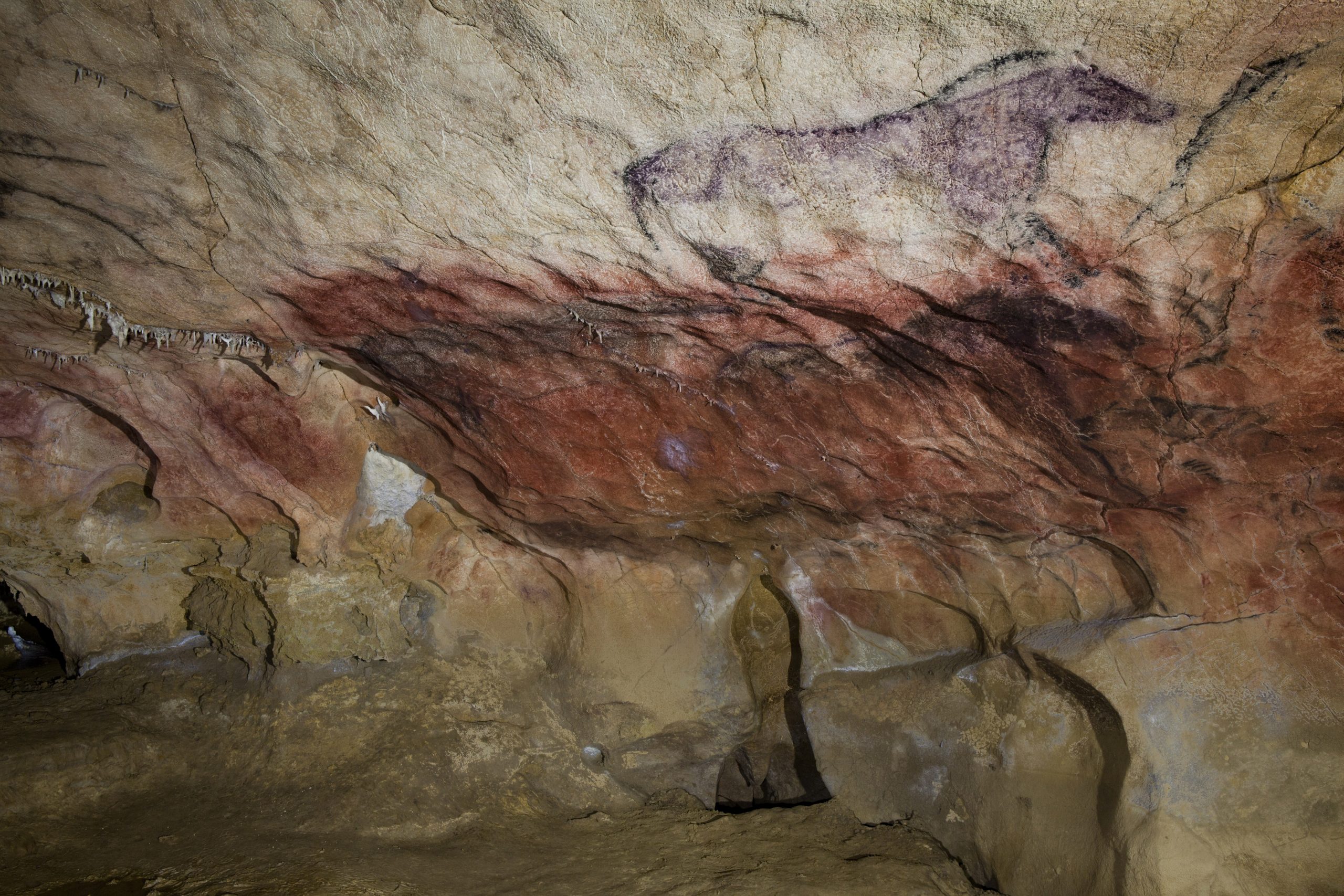
A lo largo de la galería se han encontrado 12 conjuntos decorados, de los que se muestra al público el llamado Panel Principal. Resultado de varias fases artísticas, llevadas a cabo durante 25.000 años, este conjunto es uno de los más importantes y de mayor calidad técnica de toda la zona cantábrica. Destacan representaciones de renos y caballos por su tamaño, naturalismo y complejidad técnica, ya que se combinan técnicas de pintura y grabado y variadas tonalidades, obtenidas del uso de los colores rojo, negro y violeta, con distintas intensidades en su aplicación.
Otros conjuntos importantes son el Camarín de las Vulvas, con representaciones relacionadas con el sexo femenino y la Galería de los Antropomorfos, con dos figuras humanas representadas en una misma estalactita. La llamada Galería de los Caballos reúne un excepcional conjunto de figuras grabadas, donde destacan la calidad de la ejecución, la adaptación de las figuras a la forma de la pared y su extraordinario naturalismo. Estos conjuntos no son visitables debido al difícil acceso y circunstancias derivadas de su conservación.
En la entrada de la cueva se excavó un importante yacimiento arqueológico con abundancia de restos que tienen entre 16.000 y 12.000 años de antigüedad: herramientas de piedra, una importante industria en hueso como arpones, azagayas o agujas de coser, y una extraordinaria colección de piezas decoradas.
Se puede visitar durante siete meses al año en grupos de 15 personas como máximo.
Recorrido adulto
Tito Bustillo
Es ist eine 700 m lange Galerie, zu der man durch einen künstlichen 1970 eröffneten
Tunnel gelangt, da der prähistorische Eingang auf Grund eines Erdrutsches vor
mindestens 7.000 Jahren gesperrt wurde.
Die Galerie entlang wurden 12 gemalte Kompositionen gefunden, von denen die so
genannte Haupttafel der Öffentlichkeit gezeigt wird. Als Ergebnis mehrerer
künstlerischer Phasen, die während 25.000 Jahre ausgeführt wurden, ist diese
Komposition eine der bedeutendsten und von größter technischer Qualität im ganzen
atlantischen Bereich. Hier zeichnen sich Darstellungen von Renntieren und Pferden
durch deren Größe, Naturalismus und technische Komplexität aus, da Techniken der
Malerei und Gravur sowie verschiedene Farbabstufungen kombiniert wurden. Diese
wurden dank der Verwendung roter, schwarzer und violetter Farbe mit
unterschiedlicher Anwendungsintensität erreicht.
Weitere Ausstellungselemente sind das Vulvenkammer mit auf das weibliche
Geschlecht hinweisenden Darstellungen und die Galerie der Menschenähnlichen mit
zwei menschlichen Figuren, die auf einem einzigen Stalaktit dargestellt sind. Die so
genannte Pferdegalerie versammelt eine außerordentliche Komposition eingeritzter
Figuren, wo Qualität der Ausführung, Anpassung der Figuren auf die Wandform und
herausragender Naturalismus zu verzeichnen sind. Diese Kompositionen können
wegen des schwierigen Zuganges und aus Gründen, die mit deren Erhaltung
zusammenhängen, nicht besichtigt werden.
Am ursprünglichen Eingang in die Höhle wurde eine bedeutende archäologische Stätte
mit Resten ausgegraben, die ein Alter zwischen 16.000 und 12.000 Jahren aufweisen:
Steinwerkzeuge, eine bedeutende Knochenindustrie wie Harpunen, Wurfspeere und
Nähnadeln sowie eine einmalige Sammlung an dekorierten Gegenständen.
Die Höhle kann sieben Monate im Jahr in Gruppen von maximal 15 Personen besucht
werden.
Recorrido adulto
Tito Bustillo
Il s’agit d’une longue galerie de 700 m, à laquelle s’accède par un tunnel artificiel
ouvert en 1970, parce que l’entrée préhistorique a resté fermée dû à un écroulement il
fait au moins 7 000 ans.
Tout au long de la galerie on a trouvé 12 ensembles décorés, desquels se montre au
public le dénommé Panneau Principal. C’est le résultat de plusieurs phases artistiques,
réalisées au cours de 25 000 années, cet ensemble est l’un des plus importants et de
plus grande qualité technique de toute la zone Cantabrique. Il faut souligner les
représentations de rennes et de chevaux dû à leur taille, naturalisme et complexité
technique, parce que des techniques de peinture et de gravure sont combinées et des
tonalités diverses sont utilisées, obtenues à partir des couleurs rouge, noir et violet,
avec des différentes intensités d’application.
Autres ensembles importants sont la Petite chambre des Vulves, avec des
représentations ayant rapport avec le sexe féminin et la Galerie des
Anthropomorphes, avec deux figures humaines représentées sur une même stalactite.
La dénommée Galerie des Chevaux réunit un exceptionnel ensemble de figures
gravées, où la qualité de l’exécution, l’adaptation des figures à la forme du mur et leur
extraordinaire naturalisme sont remarquables.
. Ces ensembles ne sont pas visitables dû au difficile accès et aux circonstances
dérivées de leur conservation.
À l’entrée originale de la grotte a été trouvé un important gisement archéologique où
beaucoup des restes avaient entre 16 000 et 12 000 ans d’antiquité : outils en pierre,
une importante industrie en os comme des harpons, sagaies ou aiguilles à coudre, ainsi
qu’une extraordinaire collection de pièces décorées.
La visite est possible pendant sept mois par an en groupes de 15 personnes maximum.
Recorrido adulto
Tito Bustillo
1 ARTIFICIAL TUNNEL ENTRANCE
Welcome to the Tito Bustillo cave, the most important of the four caves that make up the karstic system of the Ardines massif, both for the importance of the archaeological remains found and for the exceptional nature of the Palaeolithic cave paintings that have been preserved.
It was discovered in 1968 by a caving group that accessed the cave from the top of the mountain, through a vertical chasm, about 100 m long. This chasm was then the only possible access, since the original entrance used in Palaeolithic times, located to the southwest, at the opposite end of the mountain, was sealed off by a natural landslide shortly after the prehistoric occupation.
In order to open Tito Bustillo to mass tourism, in 1970 a decision was made to drill an artificial entrance from Ribadesella, dynamiting a 150 m tunnel, which will lead us to the interior of the cave. To do this, they take the course of the San Miguel river as a reference, an underground river that flows under the cave, from the original entrance, where it is submerged, to its exit, here on the outside. When in the tunnel, we will pass through three doors that limit air circulation to avoid altering the stable natural conditions of the cave, which maintains a constant temperature of 14ºC and 95% humidity. If you look at the tunnel lights, you will notice green patches of vegetation around them. To prevent the spread of these micro-organisms, which are extremely detrimental to the conservation of the cave paintings, there is very little light in the cave.
You will have to walk very carefully. The total route will be 1.5 km, in order to see the Main Panel: 700 m outgoing and 700 m return along the same gallery. We will do this in semi-darkness on uneven and slippery ground; leaning on walls or touching geological formations is forbidden; as well as throwing waste on the ground. Taking pictures or photographs is strictly forbidden, so the use of cameras is not allowed; the use of mobile devices is only allowed following the indications of this audio guide. At all times visitors must walk in groups, following the guide throughout the tour.
Once we start walking, the next stop is at the end of the artificial tunnel and once we enter the cave.
2 ENTRANCE TO THE CAVE AFTER THE ARTIFICIAL TUNNEL
We are now inside the cave. From here you can see the width of the main gallery, which has a total length of 700m. Along this gallery there are several secondary rooms, small and difficult to access, some of which are decorated, but which are closed to the public due to their characteristics. The Centro de Arte Rupestre describes all the decorated ensembles by means of replicas, audiovisuals, photographs and casts.
Tito Bustillo is the result of the millenary erosion of the San Miguel river on the limestone that surrounds us. As an ancient riverbed, along the route we will be able to identify the rocky outcrops that mark the old riverbeds as well as the chromatic marks of more recent floods. It is still an active cave today, where the river can run through its galleries again in the event of heavy rainfall; there is also constant water filtration, which, by dissolving the limestone and precipitating or depositing calcium carbonate, generates countless geological formations, such as lava flows, stalactites, stalagmites or columns, which will mark the entire route we will take up to the Main Panel.
To avoid getting lost on the route, bear in mind that the natural entrance is at the other end of the gallery, so the route will be the other way round: we will walk from the bottom of the cave, where we are now, towards the original entrance.
We will walk 500 metres to a new stop, just before entering to see the Main Panel.
3 THE ENTRONQUE
At 500 m along the route, we reach a crossroads in the gallery. As we arrive, the cave continues to the right for another 100 m until we reach the natural entrance used in Palaeolithic times. The original entrance is not open to visitors due to it being an archaeological research area that has not been fitted out. Usually when investigating a cave with Palaeolithic art, archaeologists always excavate at the entrance, as although there are cave paintings in very deep parts of the caves, the Upper Palaeolithic hunter-gatherer groups lived at the entrances, in the naturally illuminated spaces. The cave shelters are therefore the places where most archaeological remains related to their daily life can be found. Concerning Tito Bustillo, the excavations show evidence of an intense Palaeolithic occupation during the so-called Magdalenian culture, the last Palaeolithic cultural stage before the end of the last glaciation, which in the Cantabrian area took place between 17,000 and 11,000 years before the present.
In the same direction, very close to here, is the end of the chasm down which the discoverers descended in 1968. The early death of one of them in a mountain accident led to the cave being named after him.
We will take the other direction, entering a room that forms a small, undeveloped sack bottom. You will find the Main Panel there. For conservation reasons, the room is completely dark, so the guide will only use their torches to see the whole ensemble. As we enter, it is possible to hear the sound of the San Miguel river, which runs about 25 m below us here.
4 THE MAIN PANEL
During the visit to the Main Panel the guide will show and describe some of the most important figures in the ensemble.
It is a monumental graphic ensemble on a 20-metre-long wall. As in other Palaeolithic graphic ensembles in the Cantabrian area, it is the result of different graphic phases, painted and engraved one on top of the other over thousands of years. Dating from the Gravettian phase at least, a Palaeolithic culture that developed 25,000 years ago, until the end of the Magdalenian phase, 11,000 years ago, different generations of Palaeolithic groups entered here and used the same wall to carve their symbols. In this way, what the more modern Palaeolithic people do covers up or reduces what the older ones did, so that we, at first glance, will recognise the most recent phase, the Magdalenian one.
There are many symbols in the Main Panel, i.e., non-figurative abstract representations, either painted or engraved, forming part of the pre-Magdalenian graphic phases. What is striking about the symbols is that they appear identical in caves that are very far apart, which is evidence of a conventional graphic code, understood and shared by those societies.
The animal figures occupy the central part of the Main Panel, and belong to the Magdalenian phase. Figures of horses and reindeer are recognisable, the horse being the most represented animal in the cave. They are very naturalistic figures, some of them almost life-size, showing very precise anatomical details, such as antlers, fur, eyes or mouths.
Technically they are very simple graphic expressions: the black is obtained from charcoal, burning wood or on occasion, bone; the red is obtained from iron oxide, a mineral pigment that is very abundant in the cave. There are some purple figures, a very characteristic pigment in Tito Bustillo, due to some clays located in the area of the original entrance, which have a purplish hue as a result of a natural mixture of mineral components. The paint can be applied dry, in pencil; or diluted in water, applied with hands, brushes or some kind of leather dabber. The engraving could be done with a sharp bone awl or a stone tool called a burin, which has a very precise edge. Some figures combine painting and engraving techniques and bichromes with the use of two colours.
Although technically they are simple representations, their creation requires prior planning: in addition to preparing the dyes, it is necessary to prepare the lighting needed to move around the cave, torches in this setting, and the lighting needed to paint and engrave the walls, in this case small portable stone lamps, whose use has been demonstrated by hundreds of finds in different European caves. They also needed some kind of scaffolding structure to make some of the figures. An archaeological excavation carried out here in 1984 documented Magdalenian soil one metre below the ground we are standing on. Therefore, some of the figures are three metres above the prehistoric ground level. These excavations revealed traces of graphic activity, such as ochre pencils, burins with signs of reworking or shells and platelets with dye.
The composition of the Main Panel is highly complex: some figures reflect the attitudes and behaviour of each species. The limbs and antlers are depicted in realistic perspective and the irregularity of the wall means that some figures can only be correctly viewed from certain observation points, which do not coincide with the viewpoint of the artist.
Panels such as the one at Tito Bustillo point to a planned graphic activity, probably the result of a collective effort involving painters and assistants. It reflects an art that is to be seen by others, perhaps as a result of significant activities of importance to the group. We do not fully know its intention or meaning, but it is a homogeneous cultural happening closely linked to these Palaeolithic groups, to their ways of life, which could obey different intentions and purposes, perhaps enclosing indecipherable abstract concepts, stories, myths or legends transmitted and maintained from generation to generation for thousands of years, in different parts of the world. It reflects stable societies with high mobility and long-distance networking
Recorrido adulto
Tito Bustillo / El Pozu’l Ramu
Tito Bustillo debe’l nome a ún de los espeleólogos que formó parte del grupu que
descubrió la cueva nel añu 1968. El Pozu’l Ramu ye’l nome tradicional.
Ye una galería llarga, de 700 m de llargor, a la que s’entra per un túnel artificial abiertu
en 1970, yá que la entrada prehistórica quedó cegada por un argayu hai lo menos
7.000 años.
A lo llargo de la galería atopáronse 12 conxuntos decoraos, de los que s’enseña al
públicu’l llamáu Panel Principal. Resultáu de delles fases artístiques, llevaes a cabu nun
espaciu de 25.000 años, esti conxuntu ye ún de los más importantes y de mayor calidá
técnica de tola zona cantábrica. Destaquen representaciones de renos y caballos pol
tamañu, naturalismu y complexidá técnica, yá que se combinen técniques de pintura y
grabáu y tonalidaes variaes, llograes col usu de los colores coloráu, negru y violeta, con
intensidaes distintes na so aplicación.
Otros conxuntos importantes son el Camarín de les Vulves, con representaciones
rellacionaes col sexu femenín, y la Galería de los Antropomorfos, con dos figures
humanes representaes na mesma estalactica. La que llamen la Galería de los Caballos
axunta un conxuntu escepcional de figures grabaes, onde destaquen la calidá de la
execución, l’adaptación de les figures a forma de la paré y el naturalismu tan
estraordinariu que tienen. Estos conxuntos nun se puen visitar por mor del accesu tan
malu qu’hai a ellos y por circustancies del so caltenimientu.
A la entrada de la cueva escavóse un xacimientu arqueolóxicu importante, con
abondos nicios que tienen ente 16.000 y 12.000 años d’antigüedá: ferramienta de
piedra, una industria importante en güesu como arpones, azagayes o aguyes de coser,
y una colección estraordinaria de pieces decoraes.
Pue visitase siete meses al añu en grupos de 15 persones máximo.